
Why Choose NATIONAL
Crisis Response Canines?
Why Choose NATIONAL
Crisis Response Canines?
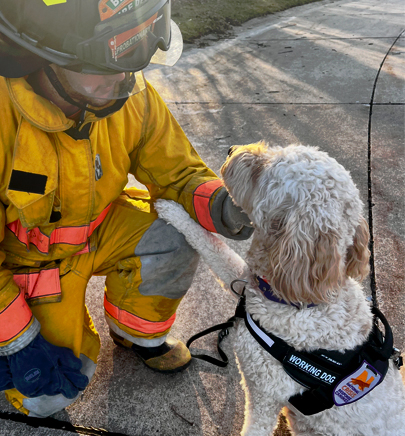
A NATIONAL Crisis Response Canines team consist of a trauma-informed handler with a working canine partner.
Unlike organizations which bring their pet dogs for friendly visits to nursing home residents or schools, NATIONAL Crisis Response Canines operates with a specialized crisis-focused model designed specifically for high-intensity, trauma-impacted environments.
Below is an overview of what distinguishes us from other crisis response and pet therapy programs.
1. Best Practices in Crisis & Disaster Response
Teams operate within:
- Incident Command System (ICS) principles.
- Psychological First Aid (PFA) concepts.
- Suicide prevention and intervention plan of actions.
- Peer support and trauma-informed care practices.
- Critical Incident Stress Management (CISM) methods.
The canine team is integrated into the response structure, not deployed independently. This ensures:
- Clear objectives and collaboration.
- Defined operational periods.
- Appropriate supervisions.
- Incident-appropriate, self-provisioned canine teams.
- Safety for survivors, responders and canines.
2. Dual Competency Model: Canine + Handler
Our Canines
- Possess a temperament for neutrality and resilience.
- Have advanced training and evaluation.
- Are stable in crisis environments (e.g., sirens, PPE, crowds, unpredictable movement).
- Recover if they become stressed.
Our Handlers
The handler is not a bystander holding a leash. The handler is a trained crisis support volunteer who partners with their canine as part of a larger stabilization strategy. They demonstrate:
- Skills in active listening and psychological stabilization.
- Understanding of trauma responses and crisis behaviors.
- Ability to recognize suicide risk factors and warning signs.
- Cultural sensitivity.
- Ability to read subtle canine stress signals.
- Ethical boundaries and consent awareness.
- A commitment to “do no harm”.
3. Evidence-Informed Mechanisms
Evidence-based practice also means:
- Clear activation pathways.
- Coordination with local agencies.
- Defined start and stop times.
- Post-deployment debriefing.
- Monitoring of canine stress load.
- Ongoing education and evaluation.
Research supports several mechanisms relevant to crisis canine work:
- Biobehavioral regulation: Human-canine interactions can reduce cortisol and increase oxytocin.
- Attachment theory principles: Safe presence supports emotional regulation.
- Polyvagal theory applications: Gentle, predictable engagement supports calming responses.
- Co-regulation: A calm dog + regulated handler helps stabilize distress.
NATIONAL applies these principles thoughtfully, avoiding sensationalism or exploitation of crisis.
4. Ethical Guardrails
Operations are conducted in accordance with established ethical standards to ensure the safety, dignity, and well-being of all individuals involved. Teams adhere to the following:
- Engagement occurs only with consent.
- Cultural considerations are respected, including individual preferences regarding touch, proximity, and interaction.
- Privacy and confidentiality are maintained, with a focus on preserving the dignity of those impacted.
- Crisis scenes and affected individuals are not used for promotional purposes.
- Canine welfare is continuously monitored, with teams withdrawing from operations when signs of stress or fatigue are observed. The well-being of the canine is regarded as equal in importance to that of the human participants.
5. Structured Deployment & Aftercare
Effective response extends beyond the moment of contact. It includes:
- Coordinated activation with partner agencies.
- Clearly defined operational timeframes.
- Utilization of the "buddy system."
- Sharing of canine and personal stress indicators.
- Post-deployment debriefing and support.
- Ongoing monitoring of both handler and canine wellbeing.
- Continued training, evaluation, and recertification.
Summary
The human+canine bond is powerful in crisis work because it engages biology, attachment, and emotional regulation. NATIONAL Crisis Response Canines ensures this bond is:
- Safe.
- Structured.
- Ethical.
- Grounded in trauma-informed training.
- Supported by measurable competencies.
The canine team does not “fix” the trauma. Instead, the canine helps create a physiological and emotional state where healing can begin.