
Our History
May 1998
Tragedy in Oregon
A 15-year old boy, obeying the command voices in his head, murdered his parents at home, then opened fire on classmates in his high school cafeteria the next day in Oregon. Our founder responds through NOVA.
May 1998
Cindy Ehlers & Bear Deploy
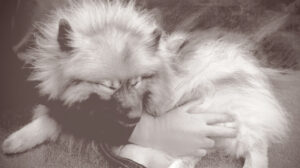
In the aftermath of the shooting, NOVA (National Organization for Victims Advocacy) deploys our founder Cindy Ehlers with her therapy dog Bear, a Keeshond, to Thurston High School in Oregon. They are joined on the deployment by Sandy Arrington with her therapy dog Garth, a Golden Retriever.
June 1998
New Crisis Response Modality Created
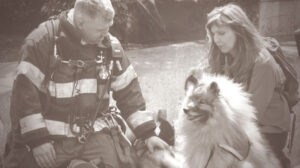
Ehlers is the first to recognize animal-assisted crisis response as a distinct, trauma-informed crisis modality. She coins the term animal-assisted crisis response (AACR), an adaptation of the common terms used for animal-assisted activities (AAA) and animal-assisted therapy (AT).
1998 -1999
Development of AACR Training
Over a period of 18 months, Ehlers develops the fundamental criteria for the selection, acclimation and core curriculum for training crisis response handlers and their working canine partners.
April 1999
Columbine High School Shooting
Two students plan and launch a grievous, deadly attack on their high school classmates, teachers, coaches and school staff in Littleton, Colorado.
The intense, sensationalized and widespread coverage of the killings, coupled with the killers' own documented motives for notoriety and mass carnage, created a toxic fascination that has since inspired countless copycat plots and attacks. The "Columbine Effect" describes this pattern of horrific imitation.
April 1999
Deployment Preparation
NOVA prepared to once again deploy the crisis canine teams. However, the benefits of this trauma-informed support was largely unknown in 1999 — and the authorization to deploy was never issued.
2000
First Training Program for Crisis Response Canine Teams Launches
Ehlers launches the first comprehensive training program specifically designed for crisis response canine teams. The emphasis is on the complex psychological/emotional conditions and challenging physical environments the canines will face. Six canine teams from Oregon participate in the inaugural training.
September 11, 2001
9/11 Terrorist Attacks
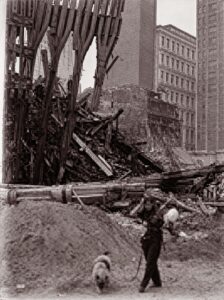
Coordinated terrorist attacks on the United States target the World Trade Center Towers, the Pentagon and the U.S. Capitol/White House — respectively, the centers of U.S. commerce, military power and democracy.
The 9/11 attack was actually the SECOND time the the World Trade was targeted. In February 1993, the first terrorist bombing of the World Trade Center kills six people, injures thousands, and causes extensive damage to the North Tower.
September 2001
Deployment to NYC
The American Red Cross, at the recommendation of NOVA, deploys Ehlers and three other crisis response canine teams to New York City.
- Cindy Ehlers with her canine Tikva, a Keeshond
- Pat Dickinson with her canine Kate, a Yellow Labrador
- Pat and Bill Gartman with their canine Uno, a German Shepherd
- Josiah Whitaker with his canine Hoss, a German Shepherd
They are initially assigned to the Family Assistance Center (FAC) at Pier 94.
September 2001
Deployment to Ground Zero
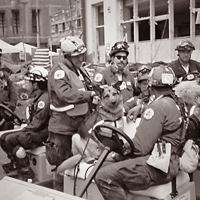
American Red Cross Chaplains, seeing the positive changes the canine teams are having on families, staff and responders at the FAC, deploy the four crisis response canine teams to Red Cross Respite Station where responders, working at Ground Zero, gather to rest.
The Chaplains also deploy the four crisis response canine teams to walk the perimeter of Ground Zero where first responders and rescuers are actively searching ‘The Pile’ for survivors.
In addition, the The New York City Mayor’s Office deploys two crisis response canine teams to support the families traveling by ferry from Pier 94 to Ground Zero to view the incomprehensible destruction for themselves, and grieve at the site where their loved ones lost their lives.
December 2001
Advanced Methodologies Adopted
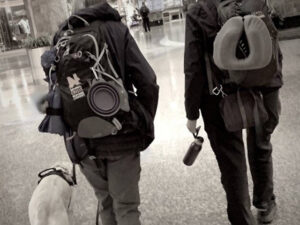
On returning from their deployment to Ground Zero, the handlers realize the need for more advanced methods of crisis intervention, safety protocols, and critical incident stress management skills for themselves and their canine partners.
Ehlers and Josiah Whitaker revise the curriculum to include:
- canine safety gear,
- de-briefing techniques,
- stress management and
- the buddy system.*
*For everyone’s safety, the ‘buddy system’ is mandated for crisis response canine teams. Each responder is partnered with another responder, and they are each responsible for maintaining communications, and remaining aware of what is necessary for the well being of each other and their canine partners.
2003
FIRST Canine Group to Establish Response Structure
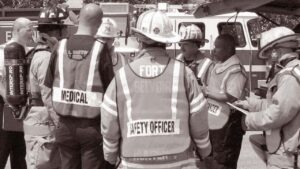
NATIONAL models its structure for responding to critical incidents on FIRESCOPE™. This model, created by an interagency group in southern California in the 1970’s, serves to coordinate agencies from multiple jurisdictions as they jointly battle wildfires across California. In 2004, FIRESCOPE principles are adopted by the FEMA and become the Incident Command System for on-scene authority and management of all-hazards incidents.
2003
FIRST to Require Canine First Aid
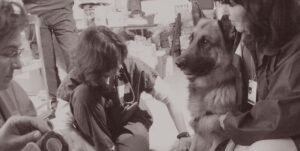
The harsh physical conditions of responding to Ground Zero, coupled with the disruption of accessible veterinary care in disaster areas, exposed the need for canine handlers to be competent in the use of canine safety gear, and prepared to provide on-scene first aid to their canine partners.
Starting in 2003, NATIONAL requires canine first aid training for all personnel responding on-scene to critical incidents.
2003
FIRST to Establish Criteria for Instructors & Evaluators
Professional credentials and critical incident response experience criteria are established for both mental health and canine behavior instructors and evaluators.
ICISF Critical Incident Stress Management (CISM) training is included in the requirements.
2006
FIRST to Require Psychological First Aid Training
The National Child Traumatic Stress Network (NCTSN) and the NATIONAL Center for PTSD jointly develop the trauma informed methodology of Psychological First Aid (PFA).
NATIONAL requires this PFA training, or equivalent, for all personnel responding on-scene to critical incidents.
April 2008
FIRST to Require Incident Command System Training

When the FEMA Emergency Management Institute (EMI) released the first online course IS-100.a — Introduction to the Incident Command System — NATIONAL makes this (and all subsequent versions of this course) a required training for all certifications and all personnel.
2010
National Standards Committee Forms
A "National Standards Committee" forms to develop the standards for the ethical training, evaluation and certification of crisis response canine teams.
This multi-disciplinary group includes responders, public health and mental health professionals, licensed social workers, professional dog trainers, and certified crisis response canine handlers.
The standards developed include the requirements and responsibilities of organizations that train, evaluate, certify or deploy the crisis canine teams.
In addition, rrecognizing the diverse and evolving environment of crisis response, the National Standards Committee includes the requirements for continuing education and recertification.
The standards are open source and may be freely adopted by any organization wishing to provide the trauma-informed support of crisis response canine teams to critical incidents.
May 2012
New Mission Statement Adopted

Re-affirming its long standing commitment to providing trauma-informed support to responders, NATIONAL adopts a new mission statement:
Our mission is to harness the power of the human+canine bond to inspire resilience and recovery in people affected by crisis, trauma or disasters, and the responders who help them.
October 29-30, 2012
Superstorm Sandy
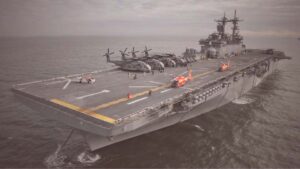
Superstorm Sandy causes catastrophic damage to New Jersey and New York, including extensive blackouts of the most densely populated city in the United States, New York City.
The U.S. Navy positions forces near the New Jersey -New York coast to support FEMA and local civil authorities. U.S.Coast Guard helicopters run arial survey missions from the amphibious assault ship.
November 1, 2012
Sandy Recovery Improvement Act = Response Changes
Just sixty days after Superstorm Sandy made landfall, the SRIA is signed into law. It authorizes sweeping changes to the way FEMA responds to federal disasters.
- Primary authority for preparedness, response, recovery and mitigation efforts fall to local, state and tribal governments.
- These changes drive the formation of community coalitions composed of local, state or tribal governments, nonprofits and the private sector working together to improve the resilience of their own communities.
- These community coalitions, well informed of the hazards and threats they face, as well as the needs, resources and gaps found in their own communities, become their community’s first line of response.
- FEMA’s role becomes that of providing supplemental assistance, resources, and leadership once a disaster is declared.
November 1, 2012
New Response Landscape for NATIONAL
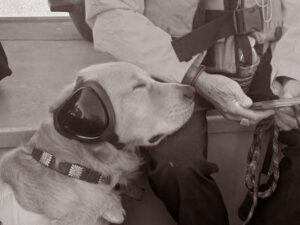
The sweeping changes of the SRIA and the concurrent creation of the community coalitions precipitates increased needs from both the number and type of agencies deploying NATIONAL crisis response canine teams.
BEFORE SRIA, NATIONAL deployments are authorized by a dozen or so national or federal agencies, for example, the American Red Cross, FEMA, or NOVA. The deployments are commonly mass casualty incidents or disasters.
AFTER SRIA, individual agencies of the community coalitions deploy our crisis response canine teams to incidents affecting a local neighborhood, a workplace, a family, or a single person. For example, a local nonprofit deploys the canine teams to their day shelter while they provide nourishing meals to people who are unhoused. Or, a local CERT team deploys the canine teams to a small mobile home park damaged by a tornado.
NATIONAL leverages lessons learned from three decades of responding to mass scale disasters, and applies them to meet the needs of thousands of community-based organizations now responsible for providing resources and aid for the crises and traumas in our own neighborhoods and hometowns each and every day.
2013
FIRST to Incorporate Real World Training for Crisis Response Canines
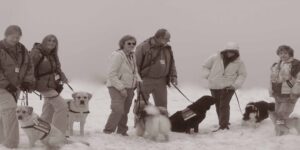
NATIONAL creates the Canis Major+Canis Minor™ mentorship for handlers and canines seeking certification as a crisis response canine team. The emphasis is on the team in-training being guided through real world experiences, working alongside experienced crisis response canine teams.
2013
FIRST to Create Distance Learning Program
NATIONAL develops the first distance learning program for training crisis response canine teams in their own communities, even in the most remote of locations. NATIONAL leverages the technology of live video conferencing over internet to create live, instructor-led classrooms online.
December 2013
FIRST to Add Mass Casualty Drill to Training Program
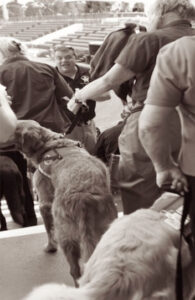
Acting on the new federal mandates for community-level command and control for the coordination, preparedness and response to critical incidents, the American Red Cross deploys NATIONAL Crisis Response Canines’ strike teams to support a multi-agency mass casualty-terrorist drill.
Dubbed Exercise Home Run, the drill is staged at a Major League Baseball® stadium in Florida. Local trauma centers, EOCs, Family Reunification Centers, federal, state and local law enforcement agencies, FEMA and fire rescue departments participate in the full scale exercise.
Crisis response canine teams fly in from Michigan, New York, Pennsylvania and Virginia to provide additional resources for the Florida-based canine teams.
NATIONAL's Canis Minor teams in-training gain real world understanding of the challenges inherent in responding to mass casualty incidents.
March 2015
FIRST to Develop Crisis Response Canine Selection Criteria
NATIONAL discovers how to objectively answer the question ‘Does this canine have the potential to thrive doing the challenging work of crisis response?’
NATIONAL first identifies 24 characteristics that exceptional crises response canines have shared in common. Then, using the CARAT™ methodology developed by Suzanne Clothier in 2007 for the selection of guide dogs for the blind, NATIONAL develops the first evidence-based criteria for the selection of crisis response canines.
March 2015
FIRST Crisis Response Canine Training in Alaska
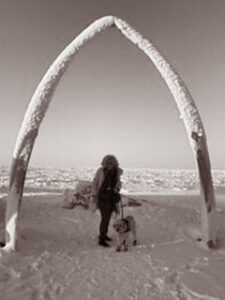
NATIONAL’s distance learning platform and Canis Minor mentorship combine to bring real world training to the most remote areas of the United States, including areas not accessible by roads.
The first crisis response canine teams training in Alaska include:
- Margaret Griffo with canine Waverly, a Keeshond
- Melissa Kitko with canine Diamond, a Border Collie
- Dennis Morner with canine Max, a Black Labrador Retriever
- Terry Yeomans with canine Sawyer, a Yellow Labrador Retriever
March 2015
FIRST: NATIONAL originates PEER Support/CISM Canine Response Certification
As crisis responders ourselves, many NATIONAL crisis response canine teams also support PEER Support and CISM teams serving responders in our own communities. These canine handlers train and earn additional IAFF* PEER Support certifications, ICISF* CISM certifications, and suicide prevention/intervention certifications.
Taken together, the PEER Support and CISM modalities form a comprehensive continuum of pre/post-incident care and crisis intervention.
To further improve the safe and effective use of crisis response canines as a trusted resource within these established modalities, NATIONAL originates the PEER Support/CISM Canine Response Certification.
This certification focuses on training canine handlers and canines to work specifically within an established CISM or PEER Support Team for firefighters, law enforcement, justice system or medical personnel following a critical incident.
The curriculum addresses topics such as the selection of canine teams; legal issues such as privileged speech and access; and understanding the policies, procedures and command structure of the community’s team.
*IAFF International Association of Fire Fighters
*ICISF International Critical Incident Stress Management Foundation
2017
FIRST Crisis Response Canine Team in Hawaii
CJ Wentzlaff with her canine partner Tolly, an English Springer Spaniel, become the first certified crisis response canine team in Hawaii.
March 13, 2020
COVID-19 Pandemic & National Emergency
The United States declares the COVID-19 pandemic a National Emergency on March 13, 2020.
NATIONAL Crisis Response Canines responds throughout the pandemic years, surge after surge. The canine teams respond to COVID-19 testing sites, hospital staff, public health departments, and vaccination PODs (points of distribution sites).
March 19, 2020 - May 13, 2023
FIRST Infection Control Protocol for Crisis Response Canines Developed
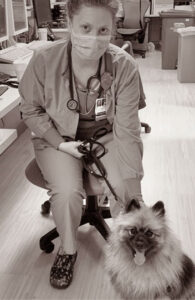
During the COVID-19 pandemic and subsequent lock down, NATIONAL Crisis Response Canines continues to support the essential services of our community partners during public health crises.
NATIONAL develops the Infection Control Protocol for its canine handlers and canines to allow them to respond to our local communities during pandemics, epidemics, endemics, outbreaks, bio-hazards and other critical incidents affecting the public’s health.
These protocols allow crisis canine teams to respond safely, including to hospital staff, throughout the duration of the pandemic without a single incident of contracting COVID-19 or its variants.
March 19, 2020 - May 13, 2023
FIRST On-demand Training for Crisis Response Canines
Once again, NATIONAL leverages the power of technology to solve the real word challenges of delivering comprehensive training to the most remote areas of the United States, its tribal areas and territories.
The distance learning is part of a hybrid learning structure that includes:
- On demand, online courses.
- Real world practicums for the handler and their canine partner in their local community.
- Live virtual classrooms with experienced responders and subject matter experts.